
The Agentic Home · Part 2 of 2
The Agentic Home
From Smart Automation to Probabilistic Intelligence

Prologue: How to Read This Document #
This paper is not a developer manual, nor is it a marketing brochure. It is written for an in-between audience: consultants, strategists, and advisors who must bridge the gap between technological potential and commercial value.
The Agentic Home is a complex idea. To position it convincingly with developers, investors, or boards, it is not enough to claim that it is “smarter” than today’s smart homes. One must understand why it is fundamentally different, how it works at an architectural level, and what implications this has for markets, business models, and long-term defensibility.
This document is therefore a technical-strategic primer. Its purpose is not to be exhaustive — it does not cover risk, liability, or regulatory integration — but to equip non-technical professionals with enough conceptual clarity to:
- Grasp the core concepts (probabilistic reasoning, multi-agent orchestration, governance),
- Acquire a shared vocabulary for boardroom and client discussions,
- Connect architecture to strategy — understanding not only what the system does, but why it matters.
Importantly, the Agentic Home is not limited to luxury villas. While premium residential real estate is an obvious early adopter, the concept extends naturally to care homes, hotels, and other non-mission-critical IoT environments. The statistical, probabilistic approach that makes the system adaptive and intelligent is not designed for mission-critical use cases (such as medical devices or industrial safety systems), where specialized deterministic techniques are required. The value of the Agentic Home lies precisely in the vast space of everyday environments where intelligence adds convenience, efficiency, and differentiation — without needing the guarantees of mission-critical engineering.
The goal is not for you to memorize every mechanism, but to gain sufficient conceptual fluency to:
- Translate technology into client value,
- Identify risks and adoption barriers with credibility,
- Position the Agentic Home as a strategic inflection point — not as another gadget.
Read it as scaffolding: a framework of concepts, examples, and logic that enables you to carry the discussion forward. What begins here as a technical description is meant to become, in your hands, a strategic narrative.
1. Executive Summary #
Smart homes promised effortless living, but today’s implementations remain largely superficial. Lights can be dimmed by voice, thermostats scheduled by app—but intelligence in the truest sense remains elusive. What exists is convenience wrapped in connectivity. What’s missing is context, anticipation, and autonomous adaptation. In other words, what is missing is the Agentic Home.
This whitepaper introduces a fundamentally new architectural approach: the Agentic Home. It moves beyond a digital butler—not an obedient servant. It acts with foresight, interprets needs before they are spoken, and functions with contextual sensitivity. This is more than deterministic rules and reactive routines. It leverages probabilistic reasoning and a multi-agent AI architecture to deliver adaptive orchestration of the home—without needing constant commands. The Agentic Home is not just smart; it is intelligent. It infers not just what is happening, but why, and adapts accordingly.
The core innovation lies in interpreting household events through probabilistic intent mapping. Rather than relying on fixed flows or static triggers, the system reasons dynamically—assigning likelihoods to potential causes and desired outcomes. This enables continuous learning, robust behavior in ambiguous scenarios, and seamless alignment with resident routines.
Built on a modular multi-agent framework, the Agentic Home delegates interpretation, evaluation, and action to specialized AI agents. These agents communicate, adjust, and evolve together. A governance layer ensures safety, explainability, and ethical transparency. The result is not a closed black box, but a transparent, adaptive decision system embedded into the home’s infrastructure.
Strategically, this architecture offers powerful implications: for residents, a frictionless living experience; for real estate developers, a premium differentiator with monetizable potential; and for platform providers, a new control layer that creates defensibility and user stickiness.
This whitepaper outlines the conceptual foundations, technical architecture, and strategic applications of the Agentic Home. It closes with a working proof of concept built on Homey Pro and n8n integration, demonstrating that this future is not theoretical—it is in development.
The following sections describe how probabilistic AI, combined with thoughtful architecture, transforms the home from a connected gadget hub into an adaptive, intelligent environment. From smart automation to probabilistic intelligence, the Agentic Home redefines what it means to live digitally.
Ambient presence, powered by RF sensing (Wi-Fi/Zigbee, etc.), allows the home to probabilistically infer occupancy without cameras or wearables. This broadens the control surface for lighting, climate, safety, and routines, while requiring discretion-by-design and explicit governance boundaries (see §6 and §5.4).
2. The Limits of 'Smart' Homes #
Most smart homes today deliver on connectivity, but fall short on intelligence. Voice commands, mobile apps, and preset flows may provide convenience, but they require continuous user input and oversight. These systems are reactive, not reflective; automated, but not adaptive.
Fundamentally, today’s smart homes operate on deterministic logic—IF-THEN statements predefined by developers or the user. This makes them rigid, fragile, and cognitively demanding to manage. Each new device or condition increases the complexity exponentially. As more devices are added, the number of possible state combinations and control permutations grows beyond what users or developers can realistically anticipate. This is the rule explosion problem.
Even modestly sized smart homes can require hundreds of rules to maintain coherent automation. Managing these rules becomes a burden. Worse, they often fail in ambiguous or overlapping contexts. A light turns on unnecessarily. A thermostat overrides user preference. The result is frustration, disengagement, and distrust in the system’s usefulness.
Some vendors layer on superficial natural language interfaces—so-called NLP wrappers. These enable voice control, but not true contextual understanding. Commands are transcribed and matched to fixed actions, with no appreciation of intent, history, or cause. These interfaces simulate intelligence without delivering it.
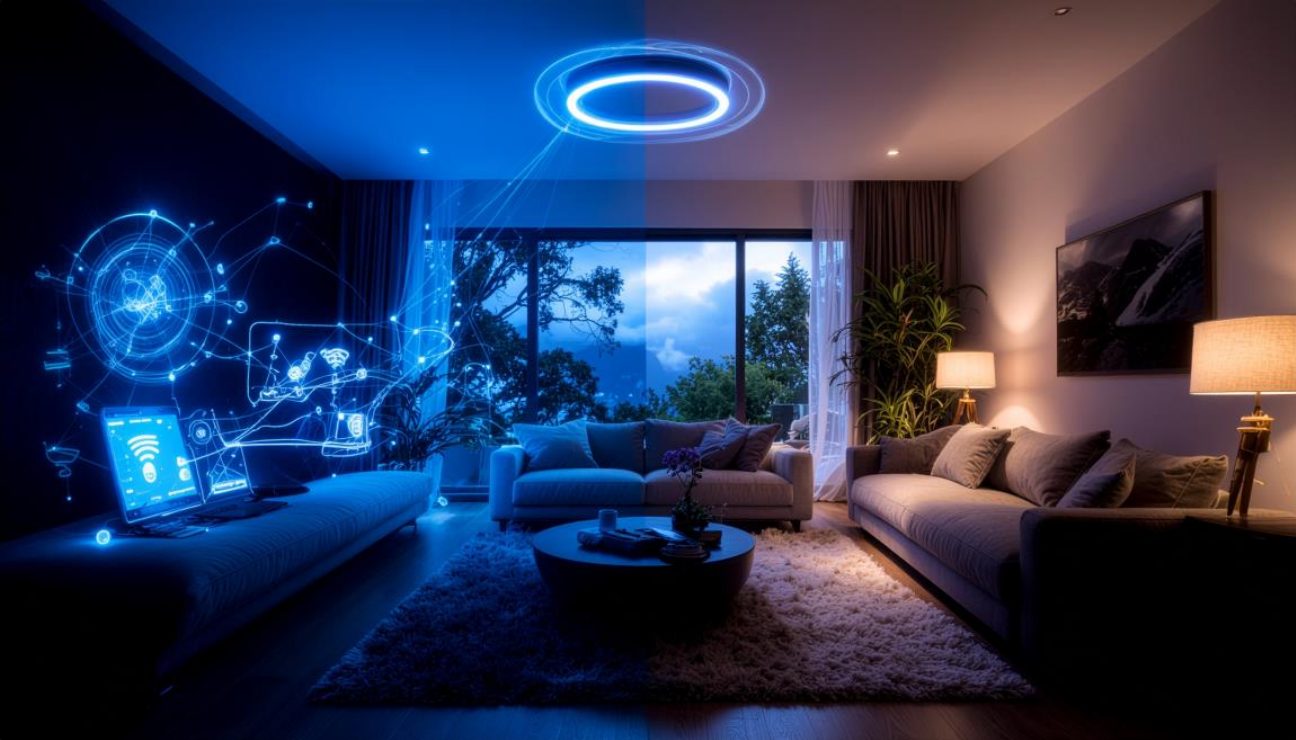
As users grow more sophisticated and homes more complex, this architecture reaches its limits. The paradigm of user-driven configuration cannot scale with device density, nor with rising expectations for ambient intelligence.
To move forward, the industry must shift from control to orchestration. Systems must infer, reason, and adapt. That requires a probabilistic, agent-based model: one that treats the home not as a programmable space, but as an evolving, interpretable environment. That is the starting point of the Agentic Home.
3. The Agentic Home Defined #
The Agentic Home is not a smarter extension of today's smart home—it is a conceptual break. Where the conventional model centers on control and automation, the agentic model is grounded in interpretation and orchestration.
At its core lies a probabilistic interpretation engine—what we refer to as the Probabilistic Context Engine (PCE). This subsystem doesn't just respond to individual triggers. It continuously evaluates environmental signals to estimate the most likely intent behind observed events. From this, it forms a live probability fabric—a dynamic representation of what the home "believes" is happening, and why.
Importantly, the Agentic Home does not react to events in isolation. Each device event contributes a weighted hypothesis about context. These are aggregated into what we call a State Probability Fabric: an evolving model that captures the emergent intent of the home environment as a whole. The system orchestrates actions not by applying fixed logic, but by interpreting this probabilistic state and inferring which response best aligns with user intent.

Take the example of closing the blinds. In a rule-based setup, the action might be coded as: “IF sunset AND presence = true THEN close blinds.” Such logic is brittle and blind to nuance. An agentic system, by contrast, considers past patterns, light conditions, room occupancy, energy trends, and time of day—inferring a likely comfort-related intent. It may act, delay, or even prompt, depending on the totality of interpreted signals.
This is not smarter automation—it is dynamic reasoning that happens on the spot, not predefined in advance. Moreover, through continuous feedback loops, the system doesn't just adapt its responses—it also learns by adjusting its own probability models over time. This means the home evolves, and so does the logic behind its reasoning. The more it is used, the better it fits the user’s patterns. If user demands shift, the system adapts—automatically and without reconfiguration. And as new devices are added to the environment, the system dynamically incorporates them into its reasoning model, updating both its perception and behavior in real time.
The Agentic Home is therefore not a device or product. It is an architectural paradigm—built on autonomous agents, orchestrated by probabilistic reasoning, and governed by feedback. It reframes the home as an evolving, interpretable system—not a programmable one.
And by doing so, it becomes a digital partner in daily life—truly a butler that continuously adapts to your needs.
4. Core Concept: Probabilistic Interpretation of Events #
Every change in device state (an event) carries implicit information—not just about what happened, but why it might have happened and what it might mean. Each state contains signals that can suggest both its likely trigger (what caused it) and its probable intent (what purpose it may serve).
The Agentic Home uses this principle to build an evolving model of household context. By analyzing the totality of active device states, the system attempts to reconstruct the most likely scenario: what sequence of causes and intents led to the current configuration. This reconstruction forms the basis for decision-making.
This is the role of the Probabilistic Context Engine (PCE). It treats every new event as a hypothesis and continuously evaluates it in light of historical patterns, concurrent states, and sensor data. Importantly, these hypotheses are not evaluated in isolation. Each contributes a probability-weighted input into a larger, dynamic structure known as the State Probability Fabric (SPF)—a contextual map of what the home believes is happening and why.
For example:
- Event: Lamp turns on at 22:00
- Possible Triggers: Motion sensor (60%), user switch (30%), automation (10%)
- Possible Intents: Comfort (70%), security (20%), notification (10%)
This single event generates 9 unique trigger–intent pairs, each with its own joint probability. These micro-inferences feed into the broader context model and collectively shape the system’s understanding of what is most likely happening—and why.
By aggregating and interpreting these micro-contexts, the system forms a probabilistic understanding of the overall household state. This composite context can then be passed to an agentic AI routine, which determines—based on this inferred context—what should happen next.

From signal to synthesis: a single event fans out into a probabilistic cascade of trigger-intent hypotheses — converging into one coherent context, and finally into a meaningful action. This is not automation; this is orchestration.
This method moves beyond event-response mapping. It enables anticipation, relevance, and restraint. If a user often turns on lights late at night for reading, the system may infer intent and gradually start preempting the action. If context shifts—e.g. presence is missing, or the pattern breaks—the system recalibrates.
This contextual reasoning happens dynamically, in real time, and evolves through continuous feedback. Each override, delay, or user correction informs the underlying probability distributions. The system learns not just better actions, but better interpretations.
Underpinning this process is a probabilistic framework based on Bayesian inference and stochastic weighting. Bayesian inference allows the system to start with a prior assumption—formed from past behavior—and continuously update that assumption as new events are observed. This ensures that the system doesn’t overreact to anomalies, but also doesn’t ignore new patterns. In parallel, stochastic weighting ensures that multiple concurrent signals (such as motion, sound, and time of day) are treated with appropriate influence based on their reliability and historical correlation. Together, these principles allow the PCE to reason with uncertainty—not in spite of it, but through it.
In essence, the Agentic Home reframes automation as hypothesis-driven orchestration. Events are clues. Context is emergent. And action is reasoned, not triggered.
5. AI Architecture: From Events to Decisions #
The Agentic Home interprets, not reacts. To achieve this, it relies on a layered AI architecture that transforms raw events into decisions through interpretation, evaluation, and orchestration.
At the foundation of this architecture lies the Probabilistic Context Engine (PCE). As explained in the previous section, the PCE evaluates each event as a probabilistic hypothesis: what triggered it, and what intent it likely expresses. These hypotheses are not binary—they are probability distributions that evolve in real time.
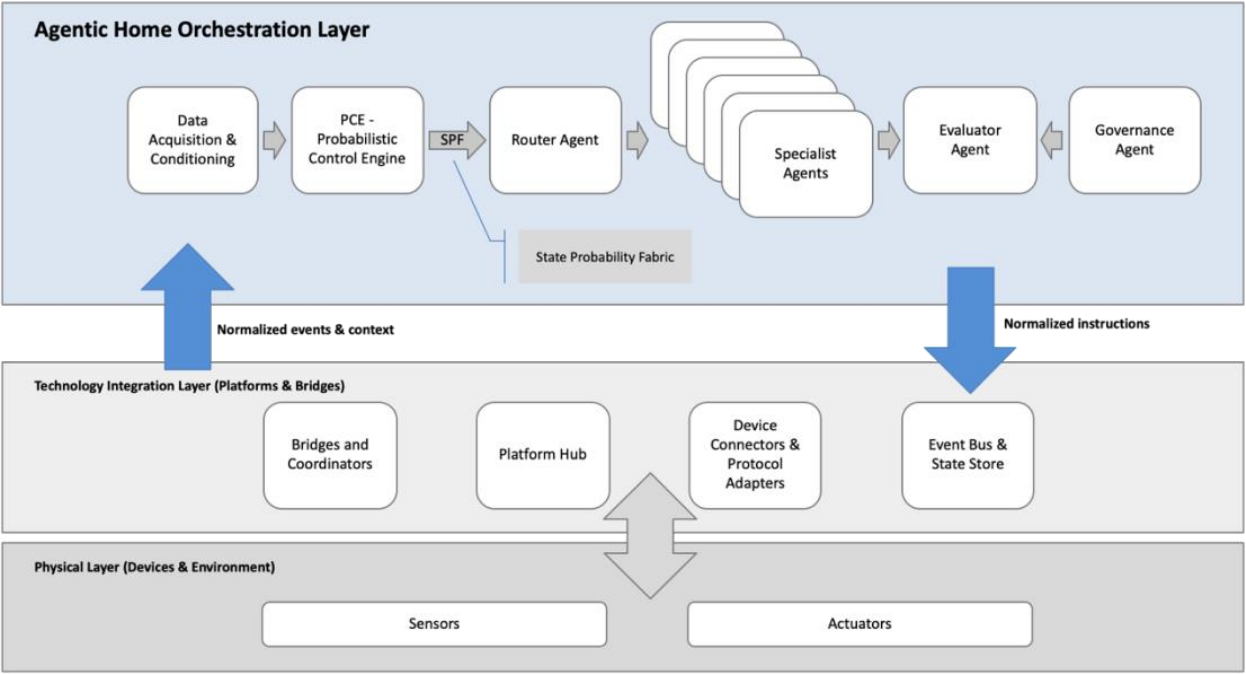
But interpreting an event is only the first step. The system must also decide what, if anything, should happen next. This is the role of the orchestration architecture: a layered stack of AI agents that collectively reason about context and generate meaningful actions.
5.1 From Interpretation to Action
The architecture follows a structured flow of information and reasoning, transforming seemingly simple events into meaningful outcomes. This process mirrors how humans handle everyday inputs—by interpreting them through context, experience, and intention.
- Event occurs (e.g., lamp turns on). This is the raw signal—the observable fact.
- PCE evaluates event → The Probabilistic Context Engine assigns probability distributions to potential triggers (e.g., motion, manual switch) and intents (e.g., comfort, security).
- State Probability Fabric updates → These micro-inferences feed into a constantly evolving probabilistic map of the home’s overall state.
- Context is routed → The context generated by the PCE is then selectively routed to agents whose domain expertise matches the likely intent of the event.
- Agents propose candidate actions → Each agent interprets the event within its scope and proposes one or more possible actions, each with a confidence score and purpose.
- Evaluator agent synthesizes → Competing or complementary actions are reviewed holistically, considering context, intent priority, user patterns, and potential conflicts.
- Governance agent validates → Before execution, the Governance Agent ensures safety, explainability, and ethical alignment.
- Decision is executed, or intentionally deferred, depending on how confident the system is and whether constraints are met.
This flow allows the system to reason before acting. It doesn't simply execute the first matched condition, as a rule-based system would. Instead, it balances context, relevance, and confidence, ensuring that actions are both timely and meaningful.
What distinguishes this process is its adaptability. Over time, each layer—interpretation, agent proposals, evaluation, and governance—evolves based on feedback. The system becomes better not only at acting, but at knowing when not to act. This balance between initiative and restraint is core to agentic behavior.
5.2 Specialist Agents and Domain Intelligence
Specialist agents are autonomous subsystems trained or tuned for a specific domain. Each one interprets context differently, depending on its functional objective and knowledge of patterns in its domain. These agents do not act in isolation—they rely on the State Probability Fabric to make sense of the evolving home environment.
- Routing Agent: Directs context-rich data toward the appropriate Specialist Agents. Based on inferred intent probabilities from the PCE, it determines which domains are relevant to the current situation—comfort, security, presence, energy, or others—and dispatches the relevant portions of the State Probability Fabric accordingly. This ensures that agents only process the information they are best equipped to interpret, optimizing load and reducing noise in the decision process.
- Comfort Agent: Manages ambiance by adjusting lighting, climate, and other comfort-related parameters. It uses patterns of activity and time-of-day correlations to make predictions about user comfort preferences.
- Security Agent: Detects anomalies in behavior, access, and system state. For instance, it may infer risk when motion is detected during known absence periods or windows are open at unusual hours.
- Energy Agent: Focuses on energy optimization, load balancing, and cost efficiency. It cross-references usage with occupancy and time-of-use tariffs to prioritize actions.
- Presence Agent: Maintains a probabilistic presence map across the home, including RF-sensing signals; see §6. It integrates sensor data, historical behavior, and indirect indicators like sound or light usage.
- RF-sensing as a signal source. The PCE treats RF-sensing (e.g., Wi-Fi CSI and Zigbee RSSI) as a continuous stream alongside PIR/mmWave and geo. We apply reliability priors by room and time-of-day, then temper actions with a Signal-Integrity Heuristic (e.g., a min-nodes rule ≥3 endpoints and dwell-time ≥N s) to suppress mirage events. Candidate actions from the Presence Agent carry extra metadata (coverage, confidence, privacy class) that the Evaluator and Governance use to choose between silent adjustments and notify/ask pathways when certainty is low or sensitivity is high.
- Scheduler Agent: Aligns system actions with calendars, routines, or external time-based constraints such as daylight or weather forecasts.
Each agent receives only the relevant portion of the context map—filtered by the PCE—to avoid unnecessary complexity. Within its scope, it proposes candidate actions, enriched with metadata such as confidence level, intended outcome, urgency, and reversibility.
This modular approach enables specialization and parallelism. Agents can be trained or evolved independently, improving their ability to anticipate intent in specific scenarios. They are not deterministic rule engines, but bounded interpreters with a continuously updated understanding of their environment.
5.3 The Evaluator: Decision Through Synthesis
The Evaluator Agent functions as a synthesizer and moderator. It does not generate actions itself—it receives candidate actions from specialist agents and weighs them against each other based on the broader household context.
For instance, a situation may arise where:
- The Comfort Agent proposes lowering the blinds to reduce glare.
- The Security Agent proposes keeping them open to maintain a visual line-of-sight.
- The Energy Agent suggests waiting 10 minutes to avoid triggering HVAC adjustments.
The Evaluator does not follow fixed rules. It dynamically resolves these proposals based on:
- The probability and strength of inferred intents.
- The historical override patterns of the user.
- Current home state and long-term behavior trends.
- Global constraints (e.g., comfort thresholds, safety protocols).
This process is non-deterministic, but traceable. The Evaluator can explain its decision, including why certain proposals were rejected. In doing so, it provides a coherent response that respects competing priorities while maintaining systemic harmony.
This synthesis mechanism enables the Agentic Home to act not just intelligently, but coherently—even under complex, conflicting conditions.
5.4 The Governance Agent
In any autonomous system, governance ensures that autonomy does not drift into unpredictability or risk. The Governance Agent serves as the system's conscience, watchdog, and translator.
It has three essential responsibilities:
- Explainability: Captures a traceable logic path for each action taken. This transparency builds user trust and simplifies debugging or refinement.
- Safety: Validates whether proposed actions pose any harm—direct or systemic. For example, it prevents executing contradictory actions or those that violate hard constraints (e.g., opening a garage at night when the alarm is armed).
- Ethics and Preferences: Maintains a high-level policy layer, informed by user-defined preferences, platform settings, and inferred value systems.
The Governance Agent is also interruptible. It allows for real-time user intervention by exposing a transparent layer of decision reasoning and confidence scores to the user interface. When confidence is low or ambiguity is high, the system can either ask for confirmation, notify the user, or allow the user to adjust the action—either preemptively or retroactively. This keeps the user in the loop in a contextual, non-intrusive way, without requiring them to be involved in every decision loop. Just like a real butler would, pausing for guidance when faced with ambiguity he cannot resolve.
As the Agentic Home matures, the Governance Agent becomes increasingly important—not to limit autonomy, but to give it shape, boundaries, and responsibility.
5.5 Continuous Learning and Adaptation
What sets the Agentic Home apart is not just its ability to decide—but its ability to learn. Each layer in the stack is part of a feedback-driven loop, continuously refining both input interpretation and output decision-making.
The PCE learns from user corrections and timing patterns. If lights are frequently overridden after an automated action, the inferred intent weights are recalibrated. Specialist agents adjust based on seasonal trends, changes in occupancy, or emerging user routines. The Evaluator adapts its resolution logic based on long-term user behavior and conflict resolution outcomes.
This learning is not monolithic. Each agent evolves semi-independently but contributes to the collective intelligence of the home. Updates to one module don’t destabilize the whole; they enhance the parts that matter.
Importantly, learning applies to both what the system does and how it reasons. The structure of probability itself changes—not just the thresholds for action. This is what enables true adaptivity.
Because the architecture is modular and probabilistic, it handles change gracefully. New devices don’t require configuration; the system interprets them probabilistically. New routines don’t break behavior—they expand it.
This is how the Agentic Home remains resilient, relevant, and responsive in the face of evolving users, technologies, and contexts.
The result is not automation. It is agentic orchestration.
The home doesn’t follow scripts—it reasons. It doesn’t just do what it’s told—it interprets what needs to be done. From first signal to final action, the Agentic Home transforms uncertainty into intelligence.
Boardroom prompts (Architecture):
- Which parts of this flow could we realistically own (vs. integrate)?
- Where do we create a defensible control point: orchestration, presence, or data?
- What ask/defer policies would increase trust without killing autonomy?
6. Presence: Awareness as the Foundation of the Agentic Home #
Presence is the cornerstone of intelligence in the home. Without knowing who is where, when, and why, no system can claim to be adaptive. Traditional smart homes approximate presence through motion sensors or phone geofencing. These methods are brittle, binary, and easy to misinterpret. A true Agentic Home requires continuous, probabilistic awareness.
6.1 RF Sensing: A Technological Breakthrough
Recent advances in RF sensing mark a step-change. By analyzing the reflection and distortion of radio signals (including WiFi, Bluetooth, Zigbee and Z-wave), systems can detect motion and even infer posture or subtle activity—without the need for dedicated cameras or wearables. Philips’ new MotionAware™ feature, announced in the Hue Bridge Pro, uses this principle to turn every light into a motion sensor. This transforms the home into a mesh of awareness: omnipresent, fine-grained, and passive. Strategically, it positions Philips to control a critical layer in the Agentic Home stack.
Example (market illustration, not endorsement): Philips Hue Bridge Pro “MotionAware™” turns lights into motion sensors via RF characteristics. This illustrates the direction of travel — ambient presence at the mesh/bridge layer — but specific vendor capabilities and markets must be validated per deployment. See §5.2 and §5.4 for handling and governance of RF signals.
6.2 Opportunities and Dilemmas
Yet, with great awareness comes a profound dilemma. What if your Agentic Home system observes something you might prefer not to know? Consider a teenage daughter spending time in her room with a boyfriend you disapprove of. The system infers prolonged presence, unusual interaction patterns, and perhaps escalates it as an “anomaly.” Should it notify you? Should it remain silent? Should it even be capable of making such inferences?
This illustrates the double edge of omnipresent presence detection. Strategically, it enables anticipation and adaptivity. Ethically, it risks intrusion and surveillance. The line between helpfulness and overreach is thin.
6.3 The Butler Standard: Discretion by Design
Here, the butler metaphor becomes instructive. A true butler’s strength lies in discretion: he observes, he acts, and he remains silent about what he knows. An Agentic Home must aspire to the same principle. Presence awareness should empower intelligent action—but without unnecessary exposure or violation of privacy. Awareness must serve anticipation, not surveillance.
6.4 Evaluator and Governance Functions
This balance is enforced through the Evaluator and Governance agents in the Agentic Home architecture:
- Evaluator weighs whether an observed context warrants action. Should presence detection trigger comfort adjustments, or is it irrelevant noise?
- Governance ensures that actions respect ethical boundaries, user-defined policies, and contextual discretion. In sensitive scenarios, the Governance agent may explicitly choose not to act—or to act invisibly—preserving trust.
Together, these functions ensure that presence does not become voyeurism. Instead, it becomes the subtle awareness of a butler: enabling anticipation, ensuring safety, but maintaining silence where discretion is paramount.
6.5 The Role of AI in Presence Decisions
This is also where the power of AI kicks in. Unlike rule-based logic, AI can weigh conflicting and ambiguous signals if given the right context. It can fuse multiple inputs—RF reflections, motion anomalies, historical patterns—and derive probabilistic judgments. These are decisions that are extremely hard to code explicitly, but tractable with machine learning models guided by policy constraints.
In practice, AI enables the Evaluator to balance context, nuance, and intent, while Governance ensures that these capabilities operate within ethical and user-defined boundaries.
Boardroom prompts (Presence):
- What presence signals can we leverage without cameras/wearables?
- Where do we draw the line between anticipation and surveillance?
- What are our notify/ask thresholds at low confidence or high sensitivity?
7. Strategic Value Creation #
To understand the value of the Agentic Home, it is helpful to define what we mean by strategic value. In the Outdoor Connect strategic growth framework, strategic value is created when a product, service, or capability contributes to three dimensions simultaneously:
- User Value – It delivers meaningful and differentiated benefits to the end user.
- Control Points – It establishes architectural, behavioral, or systemic leverage that is hard to replicate and hard to ignore.
- Scalability – It enables growth with positive economics across more users, more use cases, or more data.
Agentic systems score high on all three. They deliver relevance and convenience to users. They establish new control points in the interface layer between user intent and system execution. And their learning-by-doing nature makes them increasingly effective over time and scale.
Moreover, value creation is not limited to end users. Real estate developers, platform owners, service providers, and integrators all benefit from the architectural advantages, stickiness, and competitive defensibility that agentic systems offer. The strategic value is thus multi-actor and accumulative across the ecosystem.
7.1 For Users
From the user’s perspective, the strategic value of the Agentic Home is not just about convenience—it’s about trust, transparency, and relief from the cognitive load of managing increasingly complex smart environments. Users benefit in three interconnected ways:
- Seamless experience: The home anticipates needs and acts with subtlety. Users are not managing devices—they are simply living, and the system fits around them.
- Time savings: Traditional smart homes require constant nudging—apps, routines, reconfiguration. Agentic systems remove this friction by automating on the user’s behalf.
- Adaptive personalization: As behavior evolves (e.g., new schedules, guests, seasons), the system adapts automatically. It doesn’t just react to commands; it reflects the rhythms of life.
The result is not only improved quality of living, but also a deeper sense of calm, control, and personalization that traditional automation cannot match. This level of value once experienced becomes hard to relinquish. While this isn’t lock-in in the technical or coercive sense, it reflects the reality that once users become accustomed to true adaptivity, they are unlikely to accept less. Not only in this home, but also in future homes. It's like driving a comfortable car and then being asked to go back to a horse and pony for transportation.
7.2 For the Real Estate Market
For real estate developers and asset owners, the Agentic Home unlocks new levers for value creation, asset differentiation, and long-term tenant retention:
- Value multiplier: Properties embedded with adaptive intelligence command premium valuations—not just for novelty, but because they deliver lasting, demonstrable utility.
- Differentiation: Agentic systems offer a competitive edge in markets where most developments rely on generic smart home packages. The intelligence layer becomes a true USP.
- Stickiness: The behavioral history and learned preferences embedded in the system create emotional and functional lock-in. Users don’t just buy a home—they grow into it.

Crucially, this goes beyond traditional applications of AI, which tend to focus on task automation or predictive analytics. The Agentic Home reshapes the relationship between user and system by creating a dynamic, learning-based orchestration layer that becomes increasingly tailored over time. This not only strengthens user preference but also establishes an unfair competitive advantage—a level of differentiated value that is both hard to replicate and structurally advantaged. The result is not just increased value creation—it is cumulative, compounding, and deeply embedded in the living experience of the home itself.
7.3 For Platform Developers (incl. Hotel California effect)
For platform providers, infrastructure players, and smart home integrators, the Agentic Home offers more than just a new capability—it offers a strategic layer of leverage. This orchestration layer inserts itself between raw device signals and user-visible outcomes. Whoever controls this layer owns the user relationship, the system intelligence, and the innovation roadmap.
- New control points: The orchestration logic becomes the primary layer through which value is delivered and perceived. It replaces apps and static rules as the main interface to the system.
- Monetization: As orchestration grows in sophistication, so does the opportunity to monetize—through subscription services, orchestration-as-a-service models, or data insights.
- Network effects: Every new device or data point improves the system. As the intelligence layer learns across households, the aggregate benefit accelerates.
- Ambient-presence control point: Whoever owns the RF-presence layer at the bridge/mesh level holds a unique orchestration anchor and “Hotel California” stickiness.
- Hotel California effect1: Once a household has benefited from personalized orchestration, they will resist switching. Competitors cannot easily replicate the probabilistic context models or accumulated behavioral insights.
In short, the Agentic Home enables platforms to do more than manage devices—they define the user experience itself. They move from hardware aggregation to behavioral orchestration. This transition transforms them from enablers to orchestrators of value. They don’t just serve the ecosystem—they shape it.
Boardroom prompts (Strategy):
- Which control point (mesh/presence, orchestration, data) is most attainable for us?
- How do we compound stickiness (preferences, routines, integrations) over time?
- What is the minimal viable scope to demonstrate value within one asset/project?
8. Proof of Concept: A (Friendly) HAL-9000 in the Making #
Early implementations are being developed. These proof-of-concept systems generate dynamic code to respond to events based on probabilistic logic. While the architecture as a whole is still under construction, many underlying principles—such as agentic reasoning, Bayesian inference, and orchestration layers—are grounded in time-tested paradigms, with real-world applications across sectors.
What is novel is the cohesive integration of these components into a home automation context. This synthesis remains cutting-edge and largely unexplored in the market. Developers and technologists interested in helping build out this vision are encouraged to engage.
Unlike HAL-9000, the governance layer ensures transparency and override safety. The goal is not to remove human control, but to reduce its necessity without compromising trust.
“I’m sorry Dave, I’m afraid I can’t do that.”
This iconic line embodies the fear of autonomy without accountability. The Agentic Home is designed for the opposite: initiative with boundaries. The Governance Agent enforces contextual confidence, ethical alignment, and user intervention pathways. The system may act autonomously — but it never forgets whose home it is. #
9. Conclusion #
The Agentic Home reframes what it means to live in a digital environment. By combining probabilistic AI, multi-agent systems, and real-time learning, it creates homes that are not just smart, but intelligent. For developers, investors, and users alike, it offers a new paradigm: from command-driven convenience to adaptive, orchestrated living.
The future is not just connected.
It is aware — yet discreet.
It is contextual, autonomous, and learning.
It is governed by discretion-by-design: awareness that serves anticipation, not surveillance.
“In the Agentic Home, intelligence doesn’t ask for permission — it knows when to act, and when to remain silent.”
And perhaps most importantly: It is a future that anyone—developer or designer, builder or resident—can now help shape.
10. Note on Scope and Application #
This paper is intended as a conceptual primer, not as a practical handbook. It introduces the architecture, terminology, and strategic implications of the Agentic Home, but it does not provide ready-made frameworks, market playbooks, or implementation guides. Translating these ideas into specific strategies for real estate, hospitality, care, or platform businesses requires additional expertise, contextual analysis, and tailored execution.
Readers who wish to take this step are encouraged to develop their own approaches. Where deeper guidance is needed — from market application to board-level strategy — professional support is available.
From primer to practice: translating this architecture into market strategy and execution is out of scope here — and exactly where independent strategic advisory can make the difference.
11. Colophon #
Authorship
Author: Reinout Schotman (Outdoor Connect B.V., Netherlands) — September 2025. All opinions and errors are the author’s.
License
This work is licensed under the Creative Commons Attribution 4.0 International (CC BY 4.0) license.
License: https://creativecommons.org/licenses/by/4.0/
You are free to share and adapt this work, including for commercial use, with attribution (credit the author, title, license link, indicate changes). CC BY 4.0 already includes a disclaimer of warranties and limitation of liability (see §5 of the legal code).
Open Terminology Notice
The terms “Agentic Home”, “Probabilistic Context Engine (PCE)”, and “State Probability Fabric (SPF)” are used here as open terminology introduced by this work.
You may use these terms freely to refer to the concepts defined in this paper, including in commercial contexts, without seeking permission, provided that you:
• give reasonable attribution (author, title, link),
• do not imply endorsement or affiliation, and
• use the terms in a way that is accurate and non-misleading.
No trademark rights are asserted over these terms for descriptive use. If trademark rights are later sought for specific product/service branding, this open, descriptive use permission remains for referential use.
Attribution format
Schotman, Reinout (2025). The Agentic Home: From Smart Automation to Probabilistic Intelligence, v1.0, CC BY 4.0. Outdoor Connect B.V. [www.outdoorconnect.nl]. Changes: none / adapted.
Warranty & Liability Notice (clarification)
This publication is provided “as is” and “as available.” To the extent permitted by law, the author and Outdoor Connect B.V. disclaim all warranties (express, implied, statutory, or otherwise) and shall not be liable for any direct, indirect, incidental, consequential, special, exemplary, or punitive damages arising out of or in connection with the use of this work, including reliance on examples, configurations, or guidance. This notice does not modify or restrict the rights granted under CC BY 4.0 nor impose any additional restrictions beyond that license.
No Professional Advice
The content is for informational purposes only and does not constitute engineering, safety, legal, or other professional advice. Compliance with applicable laws, standards, and building/electrical codes remains the reader’s responsibility.
Exclusions
Logos and trademarks remain the property of their respective owners. Third-party images or diagrams are excluded unless explicitly stated. Code samples (if any) may carry separate licenses.
Notes
- The "Hotel California effect" is a concept, named after the famous Eagles song, where something is difficult to leave or escape, even when desired, due to high costs, entrenchment, or the nature of the system itself. This term is used to describe various situations, such as customers being unable to leave a service due to high switching costs, investors being trapped in a market due to high exit costs, or even a state of being consumed by a system or way of life. ↩
Cite this piece
Schotman, R. (2025). The Agentic Home. Outdoor Connect. https://outdoorconnect.nl/library/the-agentic-home/
© Outdoor Connect 2025. All rights reserved. Quote with attribution. Use and attribution