
Strategic Growth in the Mid-Market · Chapter 4
Chapter 4: The Dynamics of Strategic Competition
How midsized companies create advantage by changing the rules of the game
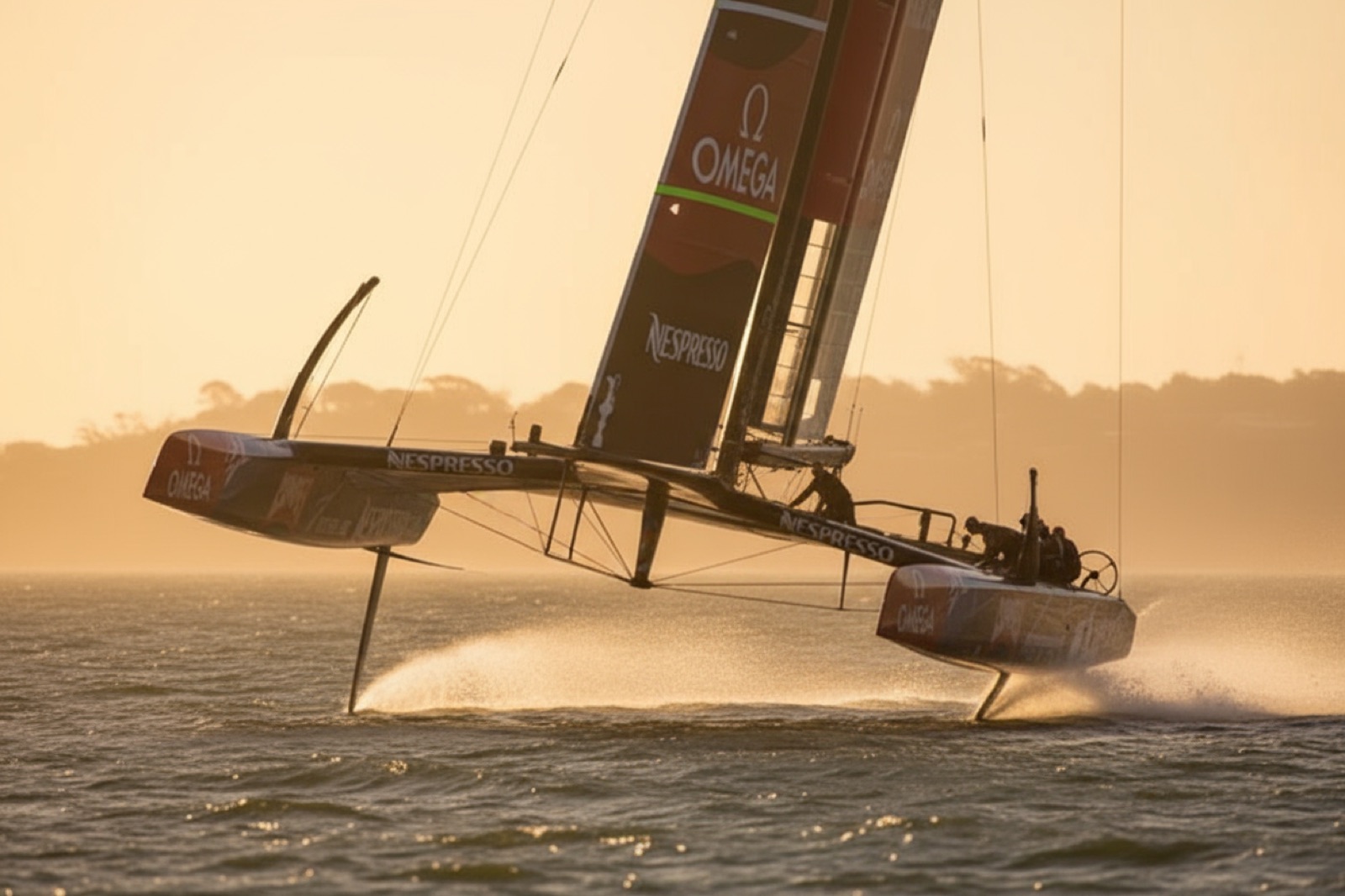
In 2013, Team New Zealand discovered that a catamaran could rise on foils, lifting entirely above the water. This breakthrough transformed sailing — from managing drag to mastering flight — and symbolises how true strategy changes the rules of the game.
Once a company has defined its market and translated vision into strategy, a deeper challenge emerges: how to compete not just effectively, but strategically. Many mid-sized firms perform well, grow steadily, and serve loyal customers — until the rules of their market quietly change. Strategic competition begins the moment leaders recognise that markets are not fixed systems, but living organisms. Advantage is not something to protect; it is something to renew.
Natural vs. Strategic Competition #
Most companies operate in what can be called natural competition — a state of gradual convergence. Competitors copy each other’s best practices, improve efficiency, and fight for share through effort. The result is sameness: everyone gets slightly better, but no one gets ahead. This logic dominates regional IT resellers, manufacturers, and service providers who compete on execution rather than intent. It is safe, familiar, and ultimately exhausting.
Strategic competition breaks that rhythm. It is based on the recognition that advantage is dynamic — it can be built, extended, or lost through deliberate moves. The goal is not to play the same game better, but to change the terms of the game itself. That shift can come from scale, innovation, timing, or from using an asset in a way others cannot easily replicate. Strategy, in this sense, is not defence; it is motion.
Recognising Strategic Instability #
Markets rarely announce when they are about to change. But instability always leaves traces. The signals are subtle: technology lowering entry barriers, customers shifting to subscription or self-service, regulation reshaping incentives, or capital flowing into adjacent segments. Mid-sized companies often detect these shifts too late — not from lack of data, but because their organisations are designed for continuity, not change.
Strategic leaders build systems of sensing. They look for weak signals in customer behaviour, competitor intent, or emerging technologies. They see inflection points early, interpret them fast, and act before certainty. The discipline is not about prediction; it is about preparedness.
Competing Through Change #
Examples across industries show how companies can tilt the rules in their favour:
- Unified Communications (Europe): As cloud platforms like Zoom and Teams disrupted on-premise telephony, Enreach reframed the game entirely. It did not chase product features but built structural control. By acquiring both local resellers and independent software vendors (ISVs) — including Swyx, Voiceworks, and HeroBase — it created an ecosystem combining technology, channel access, and customer intimacy. This combination allowed it to defend margins and steer market direction rather than respond to it.
- Logistics and Ecommerce Distribution: PostNL, DPD, and GLS recognised early that automation and data would redefine delivery value. Their early investments in parcel tracking, predictive delivery, and customerfacing transparency transformed logistics from a cost centre into a customer experience differentiator. Smaller carriers were left competing on price alone — a losing race once service became expectation.
- Advanced Manufacturing: Rehau, a German component supplier, responded to Asian price pressure by turning collaboration into control. Instead of cutting costs, it codeveloped proprietary polymer processes with Volkswagen and other OEMs, embedding itself in their design cycle and creating high switching costs. Its differentiation came not from product, but from integration.
Together these examples illustrate balance: digital ecosystems, service reinvention, and deep industrial integration — three very different expressions of the same strategic intent: using movement, not maintenance, to stay ahead.
Timing, Learning, and Advantage #
Timing matters — but learning matters more. The experience curve, a concept introduced by Bruce Henderson, shows that costs fall with cumulative output. Yet the real driver is not scale, it is learning. Companies that experiment early, learn fast, and scale what works create advantages that compound invisibly until they seem insurmountable.
Consider Exact, the Dutch SaaS firm. By deepening its integration with accountancy partners and embedding advisory capabilities into its platform, it discovered a new layer of value creation — bundling software with insight. The learnings, not the partnerships themselves, became the advantage. When competitors noticed, the opportunity had already solidified into capability.
Building the Capabilities for Strategic Competition #
Strategic competition demands four capabilities:
- Sensing – continuously scanning for weak signals and emerging substitutes.
- Option thinking – creating multiple future paths, not linear forecasts.
- Decision agility – reallocating resources when new information emerges.
- Capital discipline – making bold bets when the risk–reward balance justifies it.
These are not analytical skills; they are leadership habits. Mid-sized firms often find them scarce because operations dominate their agenda. Building them requires rhythm, reflection, and the willingness to act before the evidence is complete.
Leadership as the Strategic Lever #
Strategy cannot be delegated. Strategic competition, in particular, is a leadership discipline. It calls for judgment, not process; courage, not consensus. Leaders must decide when to disrupt their own comfort zones, when to invest against the grain, and when to change direction before competitors even recognise the shift.
The questions they should return to, again and again:
- Where is the game shifting?
- What can we do that others cannot easily copy?
- Are we shaping the market — or reacting to it?
Conclusion #
Natural competition rewards efficiency. Strategic competition rewards courage. The former keeps you in the race; the latter lets you redraw the track. For mid-sized companies, this is not an intellectual exercise — it is survival. The market will not stand still, so neither can you.
Cite this paper
Schotman, R. (2025). Chapter 4: The Dynamics of Strategic Competition. Outdoor Connect. https://outdoorconnect.nl/library/strategic-growth-chapter-4-the-dynamics-of-strategic-competition/
© Outdoor Connect 2025. All rights reserved. Quote with attribution. Use and attribution