
Essay
Reappraisal of ISVs in the Cloud (2012)
What 2012 Got Right — and What 2025 Changed Outdoor Connect — September 2025

Executive Summary #
In January 2012 Outdoor Connect published ISVs in the Cloud: considerations for a successful transition. The paper argued three core points for independent software vendors (ISVs): (1) do not own infrastructure; (2) choose cloud platforms for their commercial opportunity, not merely technical fit; and (3) re-think funding because subscriptions delay cash conversion. Thirteen years on, these arguments proved prescient. However, the world has changed in ways that were not realistically predictable then—most notably geopolitical fragmentation, regulatory sovereignty, and the countermovement toward regional cloud at scale. This reappraisal evaluates the 2012 thesis through the lenses of strategy (Porter, Henderson, Christensen), finance, and geopolitics, and sets out a practical 2025 playbook for ISV leadership teams.
Bottom line: The 2012 paper remains strong on economic logic and executional advice; its limits are the absence of geopolitics and ecosystem control points, which now dominate strategic outcomes. The modern ISV must optimize multi-cloud, regional partnerships, and compliance-by-design, while aligning go-to-market to platform marketplaces and retooling financing for recurring-revenue scale-up.
Who should read this: Board members, CEOs, CFOs, and CTOs of EU-headquartered ISVs with €50M–€1B revenue, facing regulatory or cross-border scale.
What you’ll learn: (1) How to balance hyperscalers with regional/sovereign cloud; (2) where to build control points (compute/data/model); (3) a practical playbook and board checklist to execute in 90 days.
Context: What the 2012 Paper Said—and Why It Mattered #
The white paper offered three actionable imperatives:
- Avoid owning infrastructure. Compute, storage, and networking had already commoditized. Value for ISVs sat in functional differentiation, not in building data centers. This echoed Peter Drucker’s focus on the firm’s true contribution and Bruce Henderson’s experience curve logic: hyperscalers would keep lowering unit costs faster than any ISV could.
- Select cloud on commercial grounds. Do not pick a platform solely on technical compatibility or price; evaluate the customer access and ecosystem it enables (marketplaces, installed base, SI channels). This aligns with Michael Porter’s view that competitive position depends on structure and access, not just operational efficiency.
- Fund for the subscription gap. SaaS defers revenue recognition and cash inflows; scale requires alternative sources (debt against ARR, revenue-based finance) and disciplined capital allocation.
The paper used Okta as a cautionary example: a capable product initially anchored on Salesforce’s platform, thereby limiting early addressable market. The critique was fair at the time: it highlighted how platform allegiance can slow scaling even when it does not determine ultimate success.
What the 2012 Paper Got Right (and Still Matters) #
Economic clarity. The recommendation to outsource infrastructure was—and remains—correct for the vast majority of ISVs. Owning compute is not a differentiator; product and customer outcomes are.
Platform choice as a commercial lever. In 2025, hyperscaler marketplaces (AWS, Azure, Google Cloud) and large SaaS platforms act as distribution rails. Partner attach, co-sell motions, and ecosystem readiness often outweigh marginal technical differences.
Financing realities. The subscription “cash trough” is a structural feature of SaaS. Today’s prevalence of ARR-backed credit, revenue-based financing, and growth debt validates the 2012 thesis: match financing to recurring economics and high CAC payback durations.
Management focus. The call to redirect scarce leadership attention away from commodity infrastructure toward product, go-to-market, and customer economics remains one of the most durable insights.
What Was Missing—Reasonably, Given 2012 #
The paper’s scope was technological and financial, not geopolitical. Critically, in 2012 it was not realistic to foresee:
- U.S. isolationism (2016 and 2024 Trump re-election) reshaping trade, data, and technology policy.
- Russia’s aggression (Crimea 2014; full-scale invasion of Ukraine 2022) with systemic effects on energy, supply chains, and security postures.
- Brexit (referendum 2016; exit 2020), weakening regulatory convergence in Europe.
- China’s assertive geopolitical posture from mid2010s onward; 2012 consensus still favored detente and economic convergence.
- The global COVID19 pandemic (2020–2022) further disrupted supply chains, accelerated digital adoption, and exposed the fragility of globally integrated operations.
Apart from China, each of these were unforeseen, systemic shocks that are reshaping the world today. These shocks catalyzed a bifurcated world (a split into competing regulatory and economic blocs): EU, U.S., China, Russia, and a “rest-of-world” block with divergent rules for data residency, cybersecurity, AI, and export controls. The result: global oneplatform strategies became impractical for many ISVs, not because the economics changed, but because license to operate became jurisdictionspecific.
The CounterMovement in Infrastructure (2020s) #
While hyperscalers remain dominant, a robust regional cloud segment has emerged—particularly in Europe—competing on digital sovereignty, compliance assurance, locality, and trust rather than scale economics alone. Examples include OVHcloud (FR), Hetzner (DE) and sector-focused providers; policy initiatives and regimes such as GAIAX, NIS2 and DORA amplify demand in public sector and regulated industries. The practical implications:
- Multicloud as a strategic necessity. Beyond resilience, multi-cloud is increasingly about market access (e.g., EU tenders, sectoral rules) and bargaining power.
- Hybrid patterns. Sensitive workloads in regional/sovereign clouds; global reach and advanced services (AI, analytics) via hyperscalers. Data gravity and egress costs must be engineered deliberately.
Practical checklist: workload/data placement strategy; replication & retention policy; data partitioning by jurisdiction; explicit egress budgeting; caching/edge patterns; regular cost governance.
- Compliance-by-design. Architectural decisions (data residency, key management, auditability) become board-level strategy, not mere technical settings.
This evolution does not invalidate the 2012 “don’t own infra” thesis; it complicates the choice set. The new optimum is rarely a single hyperscaler; it is a portfolio tuned to jurisdictions, risk, and gotomarket.
Strategic Analysis: From Cost Curves to Control Points #
In 2012, the paper framed strategy largely through cost curves and capital efficiency. In 2025, competitive advantage more often hinges on control points—positions in the value chain that shape rivalry. Three layers matter for ISVs:
- Compute control points (access to compliant regions; KMS/HSM sovereignty (KMS = Key Management Service; HSM = tamperresistant Hardware Security Module; “sovereignty” = retaining jurisdictional control over encryption keys); edge presence). Owning these is rare for ISVs, but choosing them wisely affects market access.
- Data control points (unique datasets, entitlements, rights, interoperability). Post–Big Data, defensibility concentrates around what you know and can lawfully use.
- Model/automation control points (domain models, workflow automation, embedded AI/ML). These raise switching costs and lock in workflows.
Porter helps dissect industry structure; Henderson explains learning effects (early movers compound); Christensenwarns of sustaining vs. disruptive trajectories. The modern ISV must locate its defendable wedge across these layers—then align infra, product, and gotomarket accordingly.
The Okta Case—A Nuanced Retrospective #
The 2012 critique—that Okta’s early platform choice constrained its initial TAM—was sound. The company ultimately escaped the constraint by building an independent identity cloud, expanding horizontally, and investing in ecosystem integrations. Two boardlevel lessons endure:
- Early platform choices shape speed more than destiny. You can recover, but you pay with time and capital.
- Ecosystem gravity compounds. Distribution, integrations, and standards adherence often determine category leadership as much as product features do.
The case validates the paper’s central warning (platforms are commercial, not merely technical); it also illustrates that worldclass execution can overcome early suboptimal choices.
A 2025 Playbook for ISV Leadership Teams #
Infrastructure & Architecture
- Adopt a portfolio stance. Define a reference architecture for dualtrack cloud: (i) hyperscaler for innovation velocity and advanced services; (ii) regional/sovereign providers for regulated segments and public sector.
- Engineer for portability. Use containerization, infra-as-code, and contractlevel SLAs to reduce hard lockin. Prioritize data portability (schemas, lineage, consent) over theoretical workload portability.
- Design for compliance. Treat residency, encryption, key ownership, and auditability as product features. Bake them into backlog and pricing.
Product & Control Points
- Own a data advantage. Codify rights, collection, and enrichment. Invest in quality (labels, ontologies), not only volume. Tie data assets to clear customer value and switching costs.
- Embed workflow and models. Build domain models and automation that integrate deeply into customer processes (high exit friction, measurable ROI).
- Ecosystem extensibility. Offer APIs/SDKs and curate a partner layer to turn your product into a small platform where feasible.
Go-to-Market & Partnerships
- Exploit marketplaces. Optimize listing, co-sell alignment, and private offers with hyperscalers to reduce CAC and improve sales velocity. Target: within 12 months, ≥20% of new ARR sourced or influenced via marketplace; use MDF and co-marketing to accelerate pipeline; align seller comp to marketplace-sourced deals.
- Regional alliances. Build joint offerings with local cloud/managed service providers to satisfy sovereignty and accelerate public-sector entry.
- Segmented propositions. Offer clear SKUs for regulated vs. unregulated use cases; price in compliance features.
Finance & Capital Allocation
- Match financing to ARR dynamics. Blend equity with ARRbacked credit or revenuebased instruments to bridge the subscription cash trough without overdilution.
- Fund control points first. Allocate capital to assets that deepen defensibility (data rights, workflow entrenchment, regulatory certifications).
- Measure learning speed. Track learning metrics (release cadence, winloss insights, partner attach) alongside traditional SaaS KPIs.
Onepage Playbook (Summary)
| Action | Why it matters | Owner | KPI | First 90 days |
|---|---|---|---|---|
| Approve dualtrack reference architecture | Market access + resilience | CTO/CISO | Signed RA; % workloads mapped by jurisdiction | Draft RA; inventory workloads; define data residency & KMS/HSM policy |
| Stand up marketplace GTM | Faster velocity, lower CAC | CRO/CMO | % new ARR via marketplace; cosell pipeline | List SKUs; enable cosell; set private offer process |
| Data/controlpoint roadmap | Differentiation & lockin | CPO/CTO | # highvalue datasets; workflow entrenchment metrics | Asset scan; pick 2 controlpoint bets; add to roadmap |
| ARRbacked credit line | Fund growth without overdilution | CFO | Facility in place; draw rules | Term sheet; board approval; covenant model |
| Compliancebydesign | License to operate | CISO/GC | Auditready controls; cert plan | Assign owner; gap assess (GDPR/NIS2/DORA); backlog items |
Exhibits #
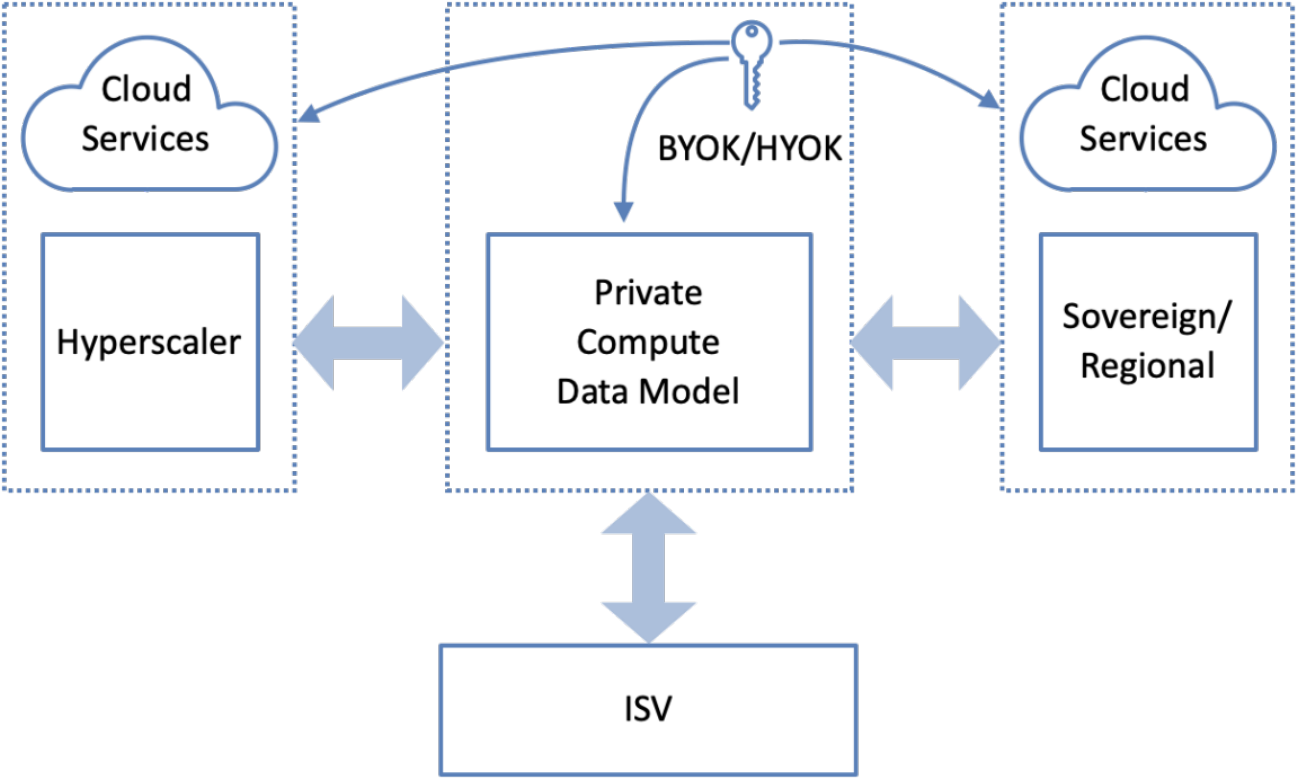
Dualtrack cloud reference architecture (schematic, simplified explanation)
This diagram shows how ISVs can combine two types of infrastructure in parallel:
- Regional/Sovereign Cloud: used for sensitive or regulated workloads, ensuring data residency and compliance (with BYOK/HYOK for key control).
- Hyperscaler Cloud: used for advanced services (AI/Analytics) and global reach, plus access to marketplaces and cosell programs.
- Key Management (KMS/HSM): sovereignty requires that encryption keys are held under local jurisdiction.
- Observability/Cost Management: monitoring overlays both tracks, ensuring that data movement and egress costs are actively managed.
Scenarios 2025–2030: What to Plan For #
- Deepening fragmentation. More jurisdictions adopt sovereignty mandates; regional cloud share rises in public sector. ISVs succeed with dualtrack architectures and regional alliances.
- Selective reconvergence. Standards and interoperability improve under market pressure; hyperscalers launch sovereignty wrappers; the edge blurs locality vs. scale. Advantage shifts to those with portable data and modular workflows.
- Regulated AI infrastructure. Sectoral rules (health, finance, public) formalize provenance, audit, and model governance. ISVs with compliancefirst architectures and verifiable pipelines win procurement.
Build options for all three; commit investment only where learning and customer pull validate the scenario.
Earlywarning indicators
- Deepening fragmentation: sovereignty clauses in RFPs; sector regulators issuing datalocality guidance; rising regional cloud share in tenders.
- Selective reconvergence: new interop standards; hyperscaler “sovereignty wrappers”; declining egress premiums; edge adoption in regulated sectors.
- Regulated AI infra: procurement demands for model provenance/audit; mandatory risk classifications; certification schemes emerging.
Decision triggers
- Reallocate 20–30% of new build to regional track when ≥30% of pipeline requires data residency.
- Increase marketplace GTM investment when cosell influenced pipeline ≥25%.
- Accelerate model governance spend when >2 key customers require auditable AI pipelines.
Board Checklist: Five NonNegotiables #
| Item | Accountable owner | Deadline | Proof of completion |
|---|---|---|---|
| Exit plan for owned data centers | CTO/CFO | 90 days to plan; 12–18 months to execute | Boardapproved plan with savings & risk reduction quantified |
| Dualtrack cloud reference architecture | CTO/CISO | 60 days | Signed RA; documented data residency & key mgmt policies |
| Control point plan (data, workflow/models) | CPO/CTO | 90 days | Roadmap entries; pricing/packaging implications captured |
| Marketplace GTM motion | CRO/CMO | 60 days | Listings live; cosell agreement; quarterly targets set |
| Capital stack aligned to ARR growth | CFO | 45 days | Facility/term sheet approved; scenario stresstests complete |
Conclusion: An EarlyWave Paper That Still Teaches the Right Lessons #
The 2012 white paper deserves recognition as an earlywave foresight document: it captured the economic essence of cloud adoption for ISVs and offered practical guidance that aged well. The world then assumed global convergence; the world now exhibits geopolitical bifurcation. That shift does not negate the core thesis—focus where you create value; rent the rest—but it changes how leaders operationalize it. In 2025, the winning ISVs combine portfolio infrastructure, defensible control points, ecosystemnative GTM, and financing tuned to recurring economics. Strategy remains what it has always been: making hard, nonreversible choices under uncertainty. The choices have moved—from data centers vs. cloud, to which clouds, in which jurisdictions, for which control points. The firms that decide clearly, execute tightly, and learn faster will write the next chapter.
Reflective Sidebar — Strategy’s Shorter Shelflife
Strategies today last 18–36 months rather than 5–10 years. This does not erode the value of strategy consulting—it raises it. Boards cannot rely on a onetime plan; they need continuous sensing, structured refresh cycles, and disciplined capital reallocation. The consultant’s role shifts from delivering a blueprint to enabling an operating rhythm of strategy: recurring diagnostics, earlywarning indicators, and option design. The premium is no longer on plan length, but on cadence and quality of rechoosing.
Disclaimer: This document provides strategic guidance and does not constitute legal or regulatory advice.
Call to action: Assess your dualtrack cloud readiness with a focused 2week diagnostic (architecture, control points, marketplace GTM), followed by a 6week execution sprint to activate the plan.
Cite this piece
Schotman, R. (2025). Reappraisal of ISVs in the Cloud (2012). Outdoor Connect. https://outdoorconnect.nl/library/reappraisal-of-isvs-in-the-cloud/
© Outdoor Connect 2025. All rights reserved. Quote with attribution. Use and attribution