
Essay
Power, Permission and the End of Illusions
Ursula von der Leyen and the Quiet Pivot of the World Order
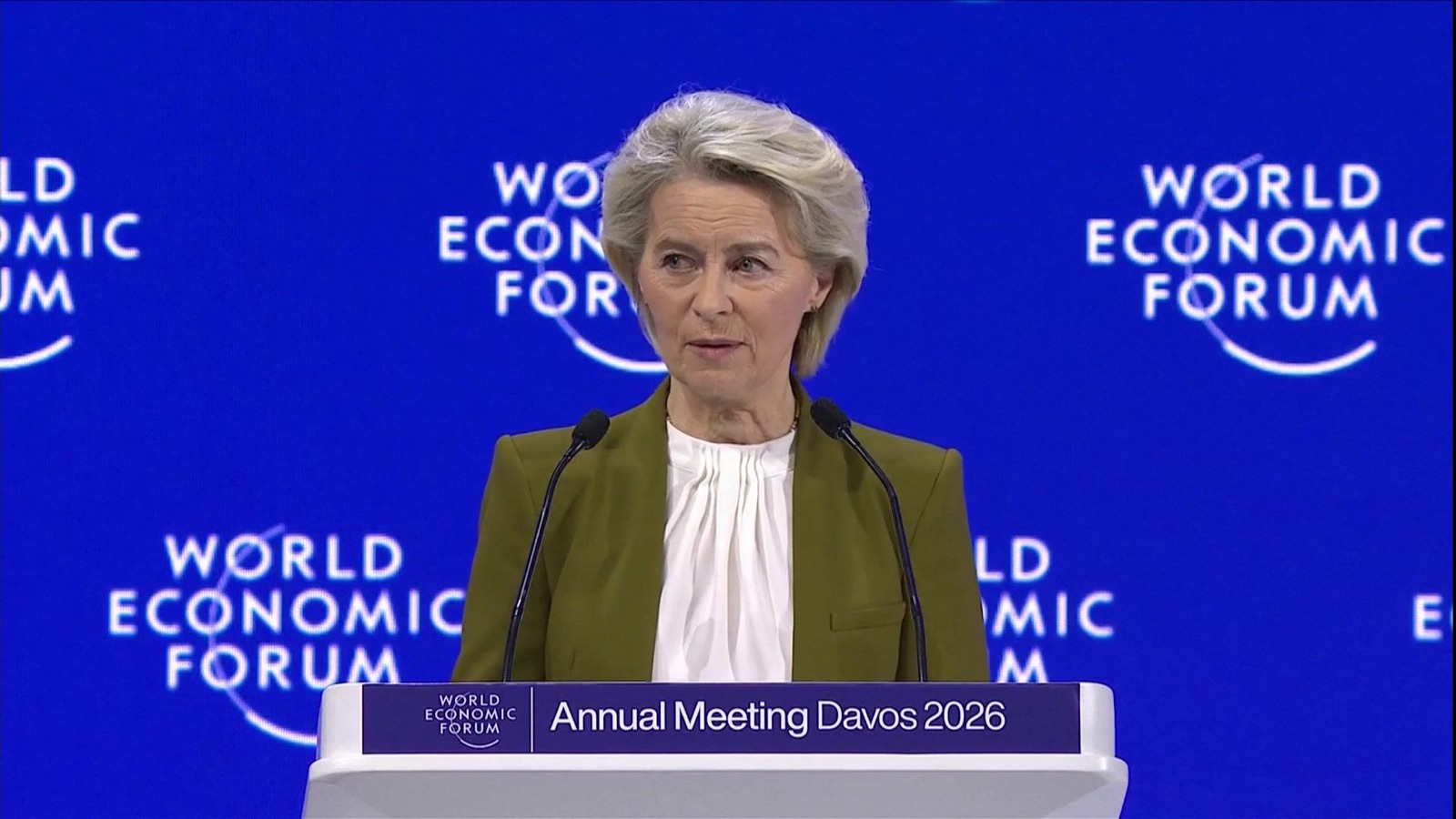
History does not always announce itself with drama. Sometimes it arrives calmly, almost bureaucratically, disguised as realism. Ursula von der Leyen’s speech in Davos was such a moment. Not a rallying cry, not a moral sermon, not a dream of a better world, but something far more consequential: the articulation of a workable one.
This was not a speech about hope. It was a speech about reality.
For decades, the international order rested on a convenient fusion of assumptions: that power would be constrained by rules, that morality would be upheld by institutions, and that American leadership would provide the implicit permission structure for global stability. That fusion has now collapsed. What von der Leyen did in Davos was not to mourn this loss, nor to dramatize it, but to replace it.
By invoking the Nixon Shock of 1971, she framed today’s moment as part of a recurring historical pattern: unilateral decisions by the United States can and do reshape the global system overnight. Europe’s mistake then was not Nixon’s action itself, but Europe’s lack of preparedness. The lesson she draws is unambiguous: geopolitical shocks are not anomalies; they are structural. And if change is permanent, Europe must change permanently too.
This single premise is what makes the speech historic.
What follows is not ideology, but system design. Von der Leyen replaces faith in norms with investment in capabilities. Trade becomes power, not virtue. Regulation becomes scale, not friction. Defence becomes industrial strategy. Energy becomes sovereignty. Capital markets become geopolitical infrastructure. These are not presented as policy silos, but as interconnected control points. This is not a Europe that seeks to be feared. It is a Europe that seeks to be unavoidable.
Crucially, this is not an anti-transatlantic turn. It is a post-dependency one. Europe does not reject cooperation with the United States; it reframes it. Partnership remains central, but only under explicit conditions: rules-based cooperation backed by power, ethics embedded in institutions rather than asserted rhetorically, and permission that must be continuously earned rather than presumed. What ends here is not the alliance, but the assumption that stability can be outsourced.
Ethics, in this framework, are not preached. They are embedded. Sovereignty is declared non-negotiable not as moral posturing, but as a design constraint. Proportionality is not promised as virtue, but as operating logic. Partnership is preferred over coercion not because coercion is immoral, but because it corrodes systems. Ethics here are not intentions; they are architecture.
Morality, too, is present, but deliberately de-emotionalised. There is no theatrical outrage, no appeal to victimhood, no personalised condemnation. Ukraine is supported not as a symbol, but as a strategic necessity. Russian assets are immobilised not as punishment, but as precedent. Morality, in this model, does not justify power; it limits it. That distinction is decisive.
Yet the most consequential concept in the speech, and the one most absent from contemporary power politics, is permission.
Von der Leyen understands something that many strongmen do not: power without permission is brittle. Permission does not mean consensus at all costs, nor does it imply weakness. It means legitimacy that is continuously renewed by citizens, partners, markets, and institutions. Her speech is a systematic act of permission-building: among EU member states, among global trading partners, among NATO allies, and among those who depend on predictability rather than dominance.
This is where the contrast with Donald Trump becomes existential rather than rhetorical. Trump operates on the assumption that power replaces permission, that leverage negates legitimacy and unpredictability equals strength. Von der Leyen operates on the opposite assumption: that in a fractured world, permission becomes the scarcest strategic resource. Those who can generate it will shape the system, regardless of who shouts the loudest.
The Greenland section crystallises this shift. Without confrontation, escalation or moral panic, she dismantles the annexation narrative by reframing security as multilateral, investment-led and sovereignty-bound. The United States is explicitly invited in, but stripped of exclusivity. Leadership is replaced by participation, control by coordination. It is a masterclass in neutralising a power play not by opposing it, but by making it unnecessary.
Critics will argue, correctly, that Europe is slow, divided and bureaucratic; that speeches do not move tanks or markets; that execution remains uncertain. All true. But this critique misunderstands how structural power actually forms. Europe is not a speedboat; it is a tanker. And tankers do not turn quickly, but once they do, the momentum is enormous and difficult to reverse.
What Davos marked was not completion, but commitment. Direction has been set. Capital is aligning. Trade architecture is expanding. Defence and energy are being re-industrialised. Optionality is replacing dependency. The question is no longer if Europe will act, but how far the new course will carry it.
This is why the speech matters beyond Europe.
What von der Leyen articulated is the emergence of a new centre of gravity in the world order, not ideological, not imperial, not revolutionary, but systemic. A Europe that no longer waits for permission from Washington, no longer assumes stability, and no longer confuses rules with power. A Europe that understands that openness must be defended, that markets are geopolitical, and that autonomy is not isolation but optionality.
History may well record this moment not as Europe challenging the United States, but as Europe outgrowing its dependence on American predictability.
Not with anger.
Not with drama.
But with structure.
In a world increasingly defined by ego, coercion and unilateralism, the quiet reassertion of power with permission may prove to be the most radical act of all.
Cite this piece
Schotman, R. (2026). Power, Permission and the End of Illusions. Outdoor Connect. https://outdoorconnect.nl/library/power-permission-and-the-end-of-illusions/
© Outdoor Connect 2026. All rights reserved. Quote with attribution. Use and attribution